Miles Fisher - This Must Be The Place
| Artist | Miles Fisher |
| Director | Dave Green |
Wiki
Additional Credits
Producer - Jake Avnet
Co-Producer - Ryan Hendricks
Director of Photography - Eric Gustavo Petersen
Production Designer - Erika Walters
Wardrobe - Rebecca Blazak
Editor - Grant Surmi
Set Design - Nick Nakahara
Production Coordinator - Daniel K. Lee
Plot Summary
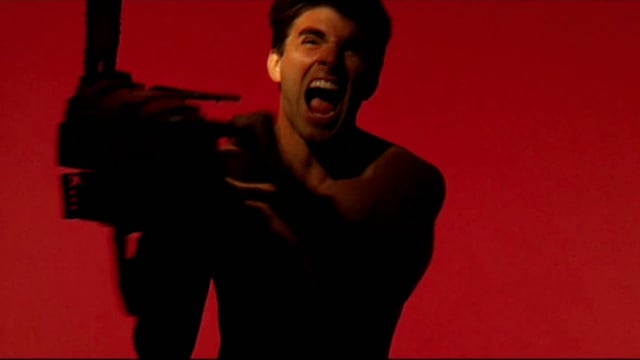
Miles Fisher’s video turns his cover of Talking Heads’ “This Must Be the Place” into a sleek, unnerving American Psycho homage. Fisher plays a Patrick Bateman-like yuppie, moving through the film’s familiar world of designer suits, obsessive grooming, business cards, luxury interiors, seduction, and sudden violence. Lydia Hearst appears as his glamorous companion while the action recreates several of the movie’s most recognizable moments, including Bateman’s confrontation with Paul Allen and the infamous axe attack. The sugary romanticism of the song makes the bloodshed even more absurdly disturbing.
Factoids & Trivia
The music came first. Fisher recorded the Talking Heads cover for his independently produced 2009 EP during the Hollywood actors’ strike, then decided that every track should receive its own visual treatment.
Fisher developed the concept with director Dave Green and producer Jake Avnet. Their aim was not a loose parody but a near-replication of American Psycho scenes, with the lyrics’ hints of fatalism providing a thematic bridge between the song and Patrick Bateman’s worldview.
Fisher’s casting helped sell the illusion. He plays Bateman himself, while Lydia Hearst was recruited for her resemblance to Cara Seymour, who played one of the prostitutes in the original film. Nick Hobbs takes the Paul Allen role, and photographer Charlotte Kidd appears as Hearst’s brunette counterpart.
The production was put together on a very small budget and shot over a single weekend in Los Angeles. A crew of American Film Institute students helped make the video, giving the ambitious remake a distinctly DIY origin.
The video deliberately blurs the line between music video and fan-made film recreation. Fisher’s performance, styling, props, and framing are designed to make viewers briefly wonder whether they are watching footage from Mary Harron’s 2000 movie.
Hearst’s participation was especially important to Fisher. He described her involvement as the element that made the project feel legitimate rather than simply like an imitation made by friends.
The cover and video became Fisher’s first major online breakthrough. According to contemporary coverage, the clip drew roughly 200,000 views on Break.com within its first 24 hours and spread rapidly across college-focused websites and video platforms.
Fisher’s choice of song is knowingly perverse: Talking Heads’ warm, vulnerable love song plays against a character modeled on one of cinema’s most emotionally vacant killers. That mismatch is the video’s central joke—and its most effective piece of horror.
Lyrics
|
Home is where I want to be
Pick me up and turn me around I feel numb, born with a weak heart Guess I must be having fun The less we say about it the better Make it up as we go along Feet on the ground, head in the sky It's okay, I know nothing's wrong, nothing I got plenty of time You got light in your eyes And you're standing here beside me I love the passing of time ... |