Madonna
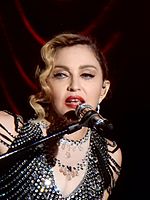

American singer, songwriter, and actress
Primarily working as: Singer
Also known as: Madonna Louise Ciccone Ritchie
So far we've got credits spanning the years %1 to %2.
Works
Wiki
Biography
Madonna Louise Ciccone, known professionally as Madonna, is an American singer, songwriter, producer, actress, director, and entrepreneur. Born on August 16, 1958, in Bay City, Michigan, she moved to New York City in 1978 to pursue dance. After working with choreographers and performing in bands including Breakfast Club and Emmy, she began developing the dance-pop sound and visual identity that would make her one of the defining artists of modern popular culture.
Madonna signed with Sire Records in 1982 and released her self-titled debut album in 1983. Built around songs such as "Holiday," "Lucky Star," and "Borderline," the album introduced her as a sharp, energetic performer with a gift for memorable melodies and club-oriented rhythms. Her breakthrough came with Like a Virgin (1984), which became her first number-one album in the United States. The title song and "Material Girl" established contrasting sides of her public persona: provocative, playful, commercially alert, and highly conscious of the power of image.
Her success expanded rapidly through music videos, television appearances, touring, and fashion. Madonna helped make the music video a central part of pop stardom, using costume, choreography, narrative, and symbolism as extensions of her recordings. True Blue (1986) broadened her musical range with songs including "Live to Tell," "Papa Don't Preach," "Open Your Heart," and "La Isla Bonita." The album topped charts internationally and confirmed her ability to move beyond the rebellious club-pop of her early work.
With Like a Prayer (1989), Madonna entered a more mature and ambitious period. The album combined pop, rock, gospel, and funk while addressing faith, family, sexuality, and social expectations. Its title song and accompanying video provoked controversy over religious imagery, but the dispute also demonstrated her ability to use publicity as part of a larger artistic strategy. The 1990 Blond Ambition World Tour further established her concerts as carefully designed theatrical productions rather than simple song performances.
Madonna continued to challenge expectations during the 1990s. Erotica (1992), the book SEX, and the film Body of Evidence emphasized an explicitly adult persona, while Bedtime Stories (1994) adopted a softer and more introspective tone. Her role as Eva Peron in Evita (1996) produced one of her strongest film performances and earned her a Golden Globe for Best Actress. The accompanying soundtrack also returned her to the center of the pop conversation.
Ray of Light (1998) marked another major reinvention. Created with producer William Orbit, it incorporated electronica, ambient textures, techno influences, and spiritually focused lyrics. The album received strong critical recognition and earned Madonna her first Grammy wins in an audio category. She followed it with Music (2000), an album that combined country and electronic elements, and American Life (2003), a politically charged project that divided listeners.
In the 2000s, Madonna returned to the dance floor with Confessions on a Dance Floor (2005), whose single "Hung Up" became an international hit. Later albums included Hard Candy (2008), MDNA (2012), Rebel Heart (2015), and Madame X (2019), each reflecting a different collaboration or stylistic direction. She has also directed the films Filth and Wisdom (2008) and W.E. (2011), and has continued to work across music, film, publishing, fashion, and philanthropy.
Inducted into the Rock and Roll Hall of Fame in 2008, Madonna is recognized for combining songwriting, performance, choreography, visual design, and self-directed reinvention. Her influence extends across pop music, music video production, fashion, and the representation of female ambition and sexuality in mainstream entertainment.