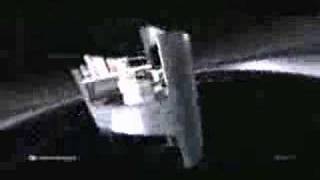
Autechre - Gantz Graf
Music Video
| Artist | Autechre |
| Song | Gantz Graf |
| Director | Alexander Rutterford |
| Genre | Dance & Electronica |
| Intro | No |
| Outro | No |
| Sound Mix | Stereo |
| Technical Specifications | colour - format unknown |
Wiki
Synopsis
A dark, abstract structure emerges against an empty black field, twitching and reshaping itself in exact response to Autechre's fractured electronic rhythm. Geometric parts appear to collide, fold inward, and explode outward as the object becomes increasingly dense and unstable. The camera moves continuously through the shifting mass, turning the video into a study of motion, texture, and sound. In its final moments, the form breaks apart and dissolves, leaving behind the impression of a machine constructed entirely from noise.
Factoids & Trivia
- The imagery was commissioned by Autechre and Warp Records as a visual counterpart to the track's detailed electronic structure.
- The animation was not generated by a reactive software system. Each three-dimensional element was manually synchronized to particular sounds and frequency ranges in the music.
- Alex Rutterford created the work in LightWave, a 3D animation program. He later described the production as taking approximately six months, including extensive testing and many evening hours.
- Rutterford said the video's central idea came from abstract imagery he experienced during an LSD trip. He also noted that the original mental images were far more complex than what could ultimately be reproduced.
- The video was produced by Lost in Space and appeared on the special DVD edition of the 2002 Gantz Graf EP, alongside videos for "Basscadet" and "Second Bad Vilbel."
- "Gantz Graf" was later included on Warp Vision: The Videos 1989-2004, a collection documenting the label's history of experimental music videos.
- Its unusually precise fusion of sound and 3D animation made the clip a landmark of early-2000s visual music and helped establish Rutterford's reputation, leading to later work connected with Radiohead.