Porter Robinson - SPITFIRE (CAPTURE THE CAN)
Music Video
| Artist | Porter Robinson |
Wiki
Synopsis
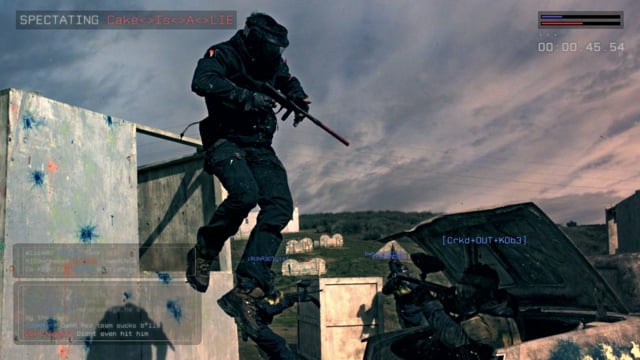
Presented as a live-action multiplayer shooter, "SPITFIRE (CAPTURE THE CAN)" drops viewers into a paintball battle staged like a first-person video game. A red-team player moves through an outdoor arena, exchanging fire with opponents while the camera tracks the action through tactical maneuvers, jumps, and close-range hits. Game-style graphics identify players, objectives, and an on-screen chat feed. The battle unfolds in dramatic slow motion, turning paint bursts, ricochets, and physical impacts into a tightly choreographed action sequence.
Factoids & Trivia
- The video was created to resemble a video game match, using a heads-up display, player labels, objective graphics, and a chat box to reinforce the game's interface.
- Much of the footage was captured with a Phantom Flex camera running at 1,000 frames per second. That allowed paint splashes, impacts, and movement to be expanded into highly detailed slow-motion sequences.
- The production was promoted as a single-take video, although the apparent continuous shot was assembled from several pieces to preserve the illusion of one uninterrupted move.
- The camera work required unusually precise coordination between the performers, camera operators, and paintball action, particularly during the vehicle leap and other moments when players cross directly through the frame.
- A behind-the-scenes piece documented the shoot, visual-effects work, and color process. The production team also noted that the high-speed camera could record only very short bursts at a time, making timing and preparation especially important.
- Paydirt Pictures produced the project, with Ross Levine and Francis Pollara serving as producers. The credited post-production team included VFX artist Alessandro Schiassi, cinematographer Justin Gunrari, editor Nate Tam, and HUD designer Cosimo Galluzzi.
- The video helped establish "Spitfire" as a track closely associated with gaming culture and machinima-style presentation, even though the action itself was filmed with live paintball players rather than rendered inside a game engine.