Wild Beasts - Brave Bulging Buoyant Clairvoyants
Music Video
| Artist | Wild Beasts |
Wiki
Synopsis
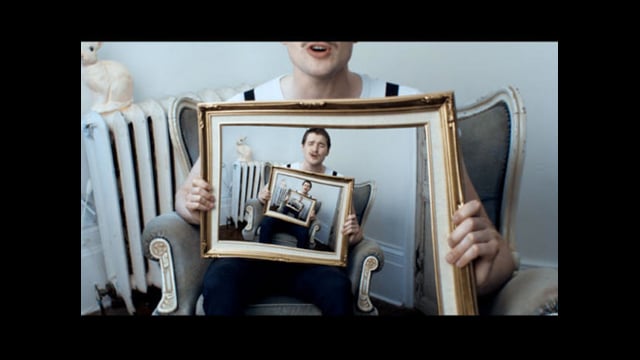
Wild Beasts perform inside a seemingly ordinary picture frame that continually folds into smaller frames, creating an endless spiral of images. As the camera plunges inward, the band members, rooms, photographs, and fragments of scenery transform and reappear in hypnotic cycles. The visual loop mirrors the song's restless, disorienting energy, turning a straightforward performance video into a surreal journey through an apparently infinite gallery. The effect grows increasingly intense as the imagery shifts in time with the music.
Factoids & Trivia
- The video is built around the Droste effect, a visual technique in which an image contains a smaller version of itself. Its main inspiration was M.C. Escher's unfinished 1956 lithograph "Prentententoonstelling" ("Print Gallery").
- Escher's original concept was so mathematically difficult that he left the center of the lithograph blank. The video's production team adapted the idea for moving images using code developed from work by Josh Sommers.
- The performance footage was shot at The Roost in Hackney on a RED camera. Director of photography Dan Trapp required the camera's full 4K resolution for the demanding post-production process.
- The visual effects were created largely in-house. The only major work handled externally was the grade and online finishing at The Mill.
- The production reportedly consumed 1,080 computer hours, suffered more than 400 crashes, and generated around two terabytes of data spread across seven hard drives.
- The images were animated to zoom in time with the beat, while the transitions were hand-animated rather than generated entirely automatically.
- The four-minute video was presented at BUG 09 at the BFI Southbank and received an MVA nomination.
- "Brave Bulging Buoyant Clairvoyants" first appeared as Wild Beasts' debut single in 2006. The video accompanied its 2008 re-release through Domino Records and its appearance on the band's debut album, "Limbo, Panto".