Grace Jones - Slave To The Rhythm
Music Video
| Artist | Grace Jones |
| Song | Slave To The Rhythm |
| Director | Jean-Paul Goude |
| Intro | No |
| Outro | No |
| Sound Mix | Stereo |
| Technical Specifications | colour - format unknown |
Wiki
Synopsis
Grace Jones is presented as a larger-than-life pop creation assembled from performance footage, advertising images, still photography, and visual effects. The video opens with Ian McShane's theatrical narration and appears to reveal the making of the iconic Slave to the Rhythm cover. It then moves through fragments from Jones' earlier work, including concert performances, music videos, and the Citroen CX commercial in which her face is stretched into surreal shapes. The result is a fast, self-referential portrait of Jones as both performer and constructed image.
Factoids & Trivia
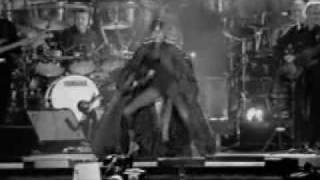
- The video contains no newly filmed performance footage of Grace Jones. It is built almost entirely from excerpts of earlier videos, the concert film A One Man Show, still photographs, and commercial material.
- The Citroen CX footage is especially recognizable for its optical effects, which extend Jones' mouth and hair into impossible proportions. The same visual language connects the advertisement with the Slave to the Rhythm album artwork.
- The opening narration is performed by Ian McShane. His voice also appears throughout the album, helping give the record the feel of a narrated pop-art presentation rather than a conventional collection of songs.
- The sequence draws on earlier Jones videos including "My Jamaican Guy," "I've Seen That Face Before (Libertango)," and "Living My Life." Existing material is re-edited so that it functions as part of a new visual composition.
- The album cover's creation is made part of the video itself. The clip shows the transformation from a photographic image of Jones into the famous manipulated portrait, turning the packaging into part of the narrative.
- "Slave to the Rhythm" received a nomination for Best Female Video at the 1986 MTV Video Music Awards. It lost to Whitney Houston's "How Will I Know."
- The song was produced by Trevor Horn and was originally developed for Frankie Goes to Hollywood before becoming a Grace Jones project.
- The album contains multiple variations and treatments of the same central song. The video mirrors that structure by remixing images from different periods of Jones' career into one continuous audiovisual collage.
Lyrics
|
Work all day, as men who know, Wheels must turn to keep, to keep the flow, Build on up, don't break the chain, Sparks will fly, when the whistle blows, Never stop the action, Keep it up, keep it up, Work to the rhythm, ... |
© Grace Jones - Slave To The Rhythm.
This is an excerpt, provided as citation under fair-use.