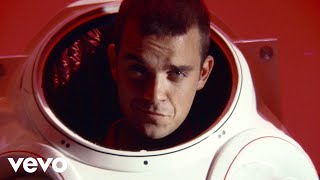
Marilyn Manson - The Dope Show
Music Video
| 1998
| Artist | Marilyn Manson |
| Song | The Dope Show |
| Album | Mechanical Animals |
| Director | Paul Hunter |
| Genre | Rock |
| Intro | No |
| Outro | No |
| Musicians | Marilyn Manson - Vocals<BR>Twiggy Ramirez - Bass<BR>Madonna Wayne Gacy - Keyboards<BR>Ginger Fish - Drums |
| Sound Mix | Stereo |
| Technical Specifications | colour - format unknown |
| Release date |
Wiki
Synopsis
An androgynous extraterrestrial version of Marilyn Manson wanders through the Hollywood Hills before being captured and examined in a clinical laboratory. Transported by limousine, he is delivered to a stage, where his fictional band Omega performs "The Dope Show" for an increasingly frenzied audience. The performance descends into chaos as fans overwhelm the barriers, while the video intercuts grotesque imagery, media satire, and surreal displays of manufactured celebrity. The result is a disturbing glam-rock spectacle about fame, exploitation, and the entertainment industry's appetite for novelty.
Factoids & Trivia
- The video premiered on August 20, 1998, during the Mechanical Animals era.
- The Hollywood Hills material was actually filmed in Simi Valley, California.
- Manson appears as an androgynous alien covered in white body paint, with prosthetic breasts contributing to the character's deliberately artificial appearance.
- The visual style draws on Nicolas Roeg's The Man Who Fell to Earth and includes imagery inspired by Alejandro Jodorowsky's The Holy Mountain.
- Several sculptural concepts associated with German artist Rebecca Horn were recreated for the production, including the striking image of Manson attached to long, red, tube-like forms.
- Billy Zane appears in the limousine sequence as a record-industry executive. The scene also spoofs celebrity media through fictionalized versions of Spin and The National Enquirer.
- The production was shot on 35 mm film. Its vintage appearance was created by heavily altering the contrast, saturation, and color tinting.
- The shoot reportedly lasted about two weeks, considerably longer than the roughly two-day schedule common for many music videos at the time.
- The video won the 1999 MTV Video Music Award for Best Cinematography in a Video, with Martin Coppen credited for the cinematography.
- It also received the Maximum Vision award at the 1998 Billboard Music Video Awards.
- Additional behind-the-scenes and unused footage from the production appeared on the 1999 video compilation God Is in the T.V.