Whitney Houston
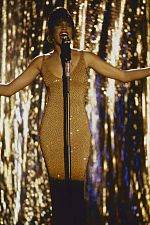
American actress and singer, model and record producer
So far we've got credits spanning the years %1 to %2.
Works
Wiki
Biography
Whitney Houston was an American singer and actress whose technically precise voice, emotional delivery, and crossover appeal made her one of the defining popular artists of the 1980s and 1990s. Often called "The Voice," she connected gospel, soul, R&B, and mainstream pop in a way that reached audiences across racial and musical boundaries. Her influence can be heard in the work of many later vocalists, while her recordings remain central to the history of modern pop music.
Born on August 9, 1963, in Newark, New Jersey, Houston grew up in a musical family. Her mother, Cissy Houston, was a respected gospel and R&B singer, and her cousin Dionne Warwick was an established pop performer. Houston began singing in church and developed her command of gospel phrasing at an early age. As a teenager, she also worked as a fashion model and appeared as a backing vocalist before pursuing a solo recording career.
In 1983, Houston signed with Arista Records, where label executive Clive Davis helped shape a career built on both vocal authority and carefully chosen pop material. Her self-titled debut album, released in 1985, initially developed slowly before becoming a major international success. It produced the hit singles "You Give Good Love," "Saving All My Love for You," "How Will I Know," and "Greatest Love of All." The album established Houston as a powerful but accessible new star, and its music videos helped make her a regular presence on MTV and other music television outlets.
Houston reinforced that success with the 1987 album Whitney. It became the first album by a woman to debut at number one on the Billboard 200 and generated four number-one singles: "I Wanna Dance with Somebody (Who Loves Me)," "Didn't We Almost Have It All," "So Emotional," and "Where Do Broken Hearts Go." The polished videos of this period presented Houston as both an elegant ballad singer and an energetic pop performer, broadening her image without diminishing the central importance of her voice.
Her third album, I'm Your Baby Tonight (1990), moved toward a more contemporary R&B sound. In January 1991, she delivered a widely praised performance of "The Star-Spangled Banner" at Super Bowl XXV. The rendition later became a commercial release and demonstrated how convincingly her vocal style could transform a familiar public song into a personal performance.
Houston's film career reached its peak with The Bodyguard (1992), in which she starred opposite Kevin Costner. The soundtrack became one of the best-selling albums in recording history, led by her version of Dolly Parton's "I Will Always Love You." Houston's performance turned the country ballad into a dramatic pop-soul anthem and earned her a Grammy Award for Record of the Year. She followed the film with roles in Waiting to Exhale (1995), The Preacher's Wife (1996), and the television musical Cinderella (1997). The soundtrack for The Preacher's Wife also highlighted her gospel roots.
After a period away from the studio, Houston returned with My Love Is Your Love (1998). The album combined contemporary R&B, pop, reggae, and gospel influences and included "It's Not Right but It's Okay," "My Love Is Your Love," and "I Learned from the Best." She also recorded "When You Believe" with Mariah Carey for The Prince of Egypt, earning an Academy Award for the song's writers and further confirming her status as a major soundtrack performer.
Houston's later releases included Just Whitney (2002), One Wish: The Holiday Album (2003), and I Look to You (2009). The last of these became her final studio album and returned to number one in the United States. Houston died on February 11, 2012, in Beverly Hills, California. She was posthumously inducted into the Rock and Roll Hall of Fame in 2020. Her legacy rests not only on record sales and awards, but on a vocal style that combined control, clarity, dramatic scale, and unmistakable emotional force.