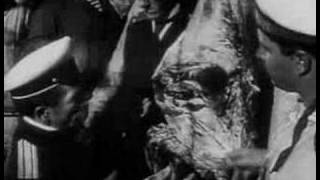
Bronenosets Potyomkin
Feature Film
| Soviet Union
| 1925
| Director | Sergei M. Eisenstein |
Wiki
Synopsis
Set in 1905, the film dramatizes a mutiny aboard the Russian battleship Potemkin after sailors revolt against brutal treatment and rotten food. When the uprising reaches Odessa, local civilians rally behind the crew, provoking a violent response from the tsarist authorities. Through stark imagery and rapid montage, the film transforms a failed revolt into a powerful portrait of collective resistance.
Factoids & Trivia
- The film was produced to commemorate the 20th anniversary of the 1905 Revolution.
- Production began as part of a larger project about the events of 1905. Because of weather, time pressure, and production difficulties, the story was narrowed to the Potemkin mutiny and its aftermath.
- The Odessa Steps massacre is the film's most famous sequence, but the episode was not part of the original screenplay and was created during production.
- The Odessa Steps sequence is a fictionalized version of history. Although violence occurred in Odessa during the 1905 unrest, the massacre depicted in the film did not happen in precisely the form shown.
- The ship used for much of the filming was not the original Potemkin. The obsolete battleship Dvenadtsat Apostolov served as a stand-in, while other naval footage helped create the film's larger-scale imagery.
- The black-and-white image of the mutineers' flag was hand-tinted red for the premiere. The tinting affected 108 frames.
- The film first screened at a ceremonial event at Moscow's Bolshoi Theatre on December 21, 1925. Its general Soviet release followed on January 18, 1926.
- International distributors circulated versions with different edits, intertitles, musical accompaniments, and censorship changes. Some versions rearranged the order of major scenes.
- Several countries restricted or banned the film because authorities feared its revolutionary message would encourage communist agitation.
- Its editing became a landmark example of Soviet montage, using the collision of shots, contrasting images, and rhythmic cutting to create emotional and intellectual meaning.
- The film has been repeatedly restored and reissued with different scores. A notable later version uses music by Dmitri Shostakovich.