Bill Murray

Works
Wiki
Biography
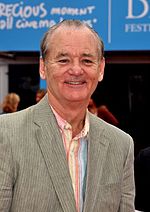
Bill Murray (born September 21, 1950) is an American actor, comedian, writer, and producer whose career has moved between television sketch comedy, mainstream film, independent cinema, and dramatic acting. Known for his dry delivery, unpredictable timing, and ability to combine sarcasm with unexpected vulnerability, Murray became one of the most distinctive screen performers of his generation.
Born William James Murray in Wilmette, Illinois, he began performing with the improvisational comedy company Second City in Chicago. He later joined the cast of Saturday Night Live in 1977, succeeding Chevy Chase. Murray quickly established himself through a relaxed but sharply observant comic style, and his work on the program earned him a Primetime Emmy Award for writing. His television success gave him a national profile and opened the way to a film career.
Murray made an early impression in Meatballs (1979), playing the irreverent summer-camp counselor Tripper Harrison. He followed it with a memorable supporting performance as the eccentric groundskeeper Carl Spackler in Caddyshack (1980), a role that helped define the offbeat comic persona he would develop throughout the 1980s. He continued with Stripes (1981), Tootsie (1982), and Scrooged (1988), demonstrating that his appeal could work in both ensemble comedies and leading roles.
His most commercially important early film was Ghostbusters (1984), in which he played Dr. Peter Venkman, a skeptical and flirtatious parapsychologist who joins a team of supernatural investigators in New York. Murray's understated performance provided a sardonic center for the film's mixture of comedy, fantasy, and action. He returned for Ghostbusters II (1989) and later appeared in further entries in the franchise, including Ghostbusters: Afterlife (2021) and Ghostbusters: Frozen Empire (2024).
Murray reached a new level of critical recognition with Groundhog Day (1993), directed by Harold Ramis. As television weatherman Phil Connors, he played a cynical man forced to relive the same day repeatedly. The film allowed Murray to move from broad comedy toward a more layered performance, tracing his character's moral and emotional transformation. It remains one of the central achievements of his career.
During the 1990s, Murray also appeared in films such as What About Bob? (1991), Kingpin (1996), and Ed Wood (1994). His career took another significant turn with Wes Anderson's Rushmore (1998), in which he played the wealthy, emotionally stalled industrialist Herman Blume. The role introduced Murray to a new generation of filmmakers and began a long association with Anderson, continuing through The Royal Tenenbaums (2001), The Life Aquatic with Steve Zissou (2004), Fantastic Mr. Fox (2009), Moonrise Kingdom (2012), The Grand Budapest Hotel (2014), and The French Dispatch (2021).
Murray's performance in Sofia Coppola's Lost in Translation (2003) brought him an Academy Award nomination for Best Actor. As aging actor Bob Harris, he balanced comic detachment with loneliness and uncertainty, showing the dramatic depth beneath his familiar screen persona. He later appeared in films including Broken Flowers (2005), Hyde Park on Hudson (2012), St. Vincent (2014), and The Jungle Book (2016). His television work in the miniseries Olive Kitteridge earned him a Primetime Emmy Award for Outstanding Supporting Actor.
Across his career, Murray has remained difficult to categorize: a mainstream comedy star, an acclaimed dramatic actor, and an ensemble performer who often brings an element of surprise to even brief appearances. His influence rests not only on individual films but also on a distinctive style that makes deadpan humor, melancholy, and improvisational energy coexist in the same performance.