Giorgio Moroder
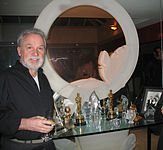

Italian record producer
Primarily working as: Composer
So far we've got credits spanning the years %1 to %2.
Works
Wiki
Biography
Giorgio Moroder (born Giovanni Giorgio Moroder on April 26, 1940, in Urtijei, South Tyrol, Italy) is an Italian composer, songwriter, producer, arranger and performer whose work helped define disco, Euro-disco and electronic dance music. His extensive use of synthesizers, sequencers and drum machines influenced later developments in hi-NRG, synth-pop, house, techno and other forms of electronic music.
Moroder began his career as a musician and singer, performing in European clubs and recording under the name Giorgio. His breakthrough came with the 1969 single "Looky Looky," which earned a gold record in several markets. After settling in Munich, he developed a production partnership with British songwriter Pete Bellotte. Together they established a highly individual studio sound based on repetitive electronic bass lines, layered keyboards and a strong dance-oriented pulse.
The partnership became particularly important through their work with Donna Summer. Moroder and Bellotte produced and co-wrote a series of influential recordings, including "Love to Love You Baby," "I Feel Love," "Hot Stuff," "Bad Girls," "Last Dance" and "On the Radio." Released in 1977, "I Feel Love" was especially significant for placing an almost entirely electronic rhythm at the center of a major pop recording. Its mechanical pulse and hypnotic arrangement became a landmark in the history of electronic dance music.
Moroder also maintained a solo career. Albums such as *From Here to Eternity* (1977) and *E=MC2* (1979) presented his electronic approach in a more direct form, with Moroder using the studio as both an instrument and a compositional tool. He founded Oasis Records and Musicland Studios in Munich, facilities that became associated with major international recording projects.
Film music eventually became another major part of Moroder's career. He won the Academy Award for Best Original Score for *Midnight Express* (1978), whose electronic score helped establish a new model for synthesizer-based film music. He later wrote or produced prominent songs for *American Gigolo*, including Blondie's "Call Me," and for *Flashdance*, including "Flashdance...What a Feeling," performed by Irene Cara. The latter earned him another Academy Award, shared with Cara and Keith Forsey.
His success continued with *Top Gun* (1986), for which he co-wrote Berlin's "Take My Breath Away." The song won the Academy Award and Golden Globe for Best Original Song. Moroder also contributed music to films including *Scarface*, *The NeverEnding Story*, *Electric Dreams*, *Superman III*, *Rambo III* and *Beverly Hills Cop II*. In 1984, he created a revised version of Fritz Lang's silent classic *Metropolis*, adding color tinting, intertitles and a contemporary pop soundtrack.
Beyond records and films, Moroder wrote music for major international events, including the 1984 Los Angeles Olympics, the 1988 Seoul Olympics and the 1990 FIFA World Cup. His later work included the Grammy-winning Donna Summer collaboration "Carry On" and a prominent appearance on Daft Punk's 2013 album *Random Access Memories*. The track "Giorgio by Moroder" introduced a new generation to his story and methods.
Moroder's honors include three Academy Awards, four Golden Globes and four Grammy Awards. His lasting importance lies in the way he connected pop songwriting, club music, film scoring and emerging electronic technology.