Allen Ginsberg - Ballad Of The Skeletons
Music Video
| Artist | Allen Ginsberg |
| Song | Ballad Of The Skeletons |
| Intro | No |
| Outro | No |
| Sound Mix | Stereo |
| Technical Specifications | colour - format unknown |
Wiki
Synopsis
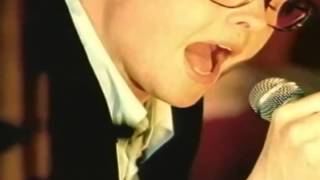
Allen Ginsberg delivers his politically charged poem directly to the camera, appearing against a stark white background while a rapid collage of historical and contemporary images unfolds around him. Archival footage of civil rights marches, the Watts riots, the moon landing, political figures, war imagery, and atomic destruction reflects the poem's catalog of social and political "skeletons." The intimate performance footage contrasts with the turbulent montage, turning Ginsberg's rhythmic recitation into an urgent audiovisual protest.
Factoids & Trivia
- The video was shot in September 1996 at Ginsberg's New York home. His performance was filmed against white paper and later combined with archival material.
- The montage includes footage associated with the Watts riots, civil rights demonstrations, the moon landing, politicians, and the atomic bomb, matching the poem's attack on American power and public life.
- "Ballad of the Skeletons" began as a poem published in The Nation in November 1995. Ginsberg used the recurring skeleton image to suggest the temporary nature of political figures, institutions, and public controversies.
- The recording was produced by Lenny Kaye and featured Ginsberg with Paul McCartney, Philip Glass, Marc Ribot, and David Mansfield. McCartney contributed guitar, drums, Hammond organ, and maracas, while Glass added keyboard parts.
- McCartney first accompanied Ginsberg during a 1995 poetry performance at London's Royal Albert Hall. He later helped develop the studio recording.
- Mercury issued the track as a stand-alone maxi-single rather than as part of a full-length album. It appeared in both an unedited version and a version with language altered for radio and television.
- The short received a Special Mention at the International Short Film Festival Oberhausen in 1998.